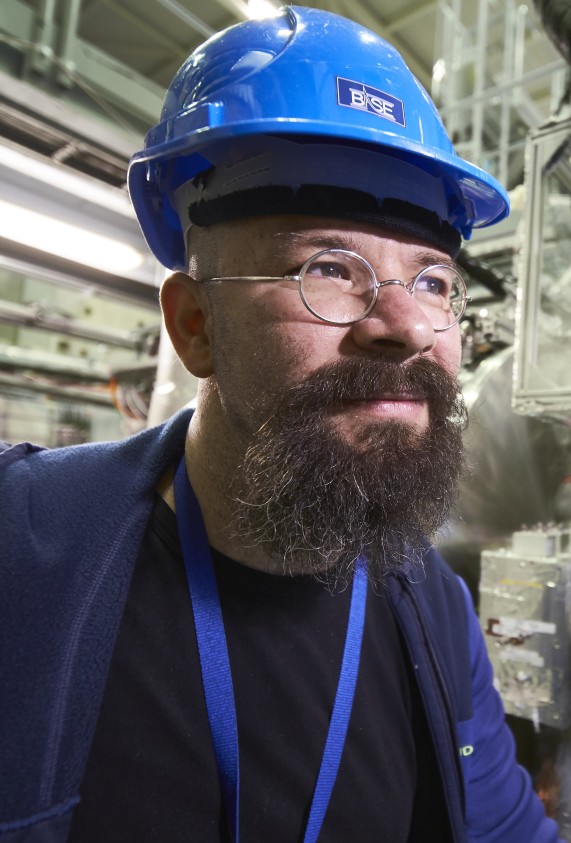
 Prof. Stefan Ulmer
Heinrich Heine University Düsseldorf (HHU), Germany
Stefan Ulmer is Professor of Experimental Physics at Heinrich Heine University Düsseldorf (HHU), Germany, Chief Scientist at RIKEN, Japan, and founder and spokesperson of the BASE collaboration at CERN. His pioneering research focuses on ultra-high precision measurements of the fundamental properties of matter and antimatter using Penning-trap techniques. He received his PhD for the first observation of spin flips with a single trapped proton — a milestone experiment that laid the foundation for precision measurements of the magnetic moments of the proton and antiproton. Building on this breakthrough, the BASE collaboration later achieved the most precise measurement of the proton magnetic moment, reaching a fractional precision of 3 parts per billion. In 2012, Ulmer joined the ASACUSA antihydrogen experiment at CERN, contributing to the production of the first antihydrogen beam while simultaneously initiating the BASE experiment. During BASE’s first operational run in 2014, his team performed the most precise CPT symmetry test with baryons by comparing the proton-to-antiproton charge-to-mass ratio with a fractional precision of 69 parts per trillion, later improved to 16 parts per trillion — establishing one of the world’s most stringent tests of matter–antimatter symmetry. Prof. Ulmer also invented the antiproton reservoir trap technique, enabling long-term storage of antiprotons independently of accelerator cycles. This innovation became the blueprint for modern transportable Penning-trap systems and portable antimatter experiments such as BASE-STEP. In 2016, the collaboration demonstrated antiproton storage times exceeding 405 days. BASE further achieved the most precise measurement of the antiproton magnetic moment, first at the parts-per-million level and later at parts-per-billion precision. More recently, Ulmer and collaborators realized the first coherent spectroscopy of a single antiproton spin — recognized among the Top 10 Physics Breakthroughs of 2025. Beyond antimatter physics, his research explores physics beyond the Standard Model, including searches for axion-like particles and millicharged dark matter using advanced quantum sensing technologies. For his scientific achievements, Prof. Ulmer received the IUPAP Young Scientist Prize in 2014 and the Falling Walls Breakthrough Award in 2022.