Workshop on Quantum Entanglement
📅 July 03 – 04, 2026
Krakow, Poland
Welcome
One of the main purposes of the workshop is to exchange experiences in theoretical and experimental studies of quantum entanglement across particle and nuclear physics, quantum computing, and material science, as well as emerging applications in medicine.
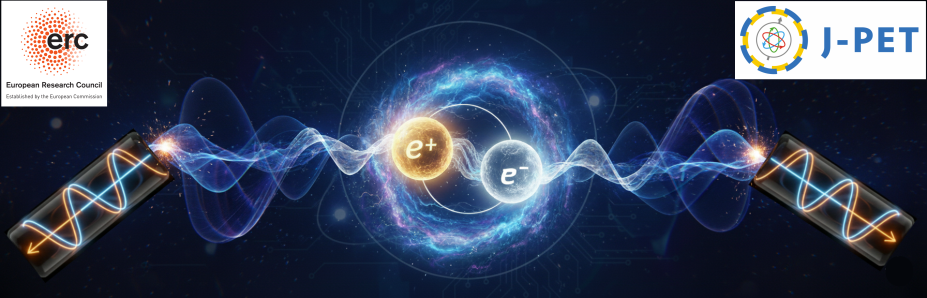
The workshop is organized within the framework of the ERC Advanced project POSITRONIUM, which aims to test the hypothesis that tissue oxygenation may be sensed by measuring the degree of entanglement of photons originating from positronium. This research is motivated by the recent discovery, published in Science Advances, that photons from positronium annihilation in matter are not maximally entangled.
The workshop is a satellite meeting of the 6th Jagiellonian Symposium on Advances in Particle Physics and Medicine (JS:2026)
The scientific scope covers the following fields:
- Quantum entanglement of photons from positronium annihilation.
- Quantum entanglement of photons from positron annihilation in matter.
- Quantum entanglement in particle pairs produced at lepton and hadron colliders.
- Quantum entanglement in quantum computing.
- Quantum entanglement in positron emission tomography.
- Degree of quantum entanglement as a diagnostic biomarker.
Meeting Agenda
| Friday, 03.07.2026 | |
|---|---|
| 12:00 – 18:00 | Scientific Sessions |
| 19:00 | Networking Dinner |
| Saturday, 04.07.2026 | |
| 09:00 – 18:00 | Scientific Sessions |
| 19:00 | Networking Dinner |